Home How We Do It Operations Leaders Improvers Tech Vendors About Blog Book a Demo
From Problems to Purpose

Your Technology Works.
Your Operation Struggles.

Every system is green. But the nurse still can't find the IV pump. It's time to align technology with what your organization actually needs to achieve.

What gets measured gets managed. What gets aligned gets achieved.

See How It Works

Precursor gives healthcare organizations something they've never had — a complete, goal-oriented model of how their operation is designed to work. One that AI can read, reason about, and use to surface what no dashboard has ever shown them. We deliver that through a methodology that models your operation, a platform that makes it live and measurable, and a consulting engagement that builds and maintains it with you.
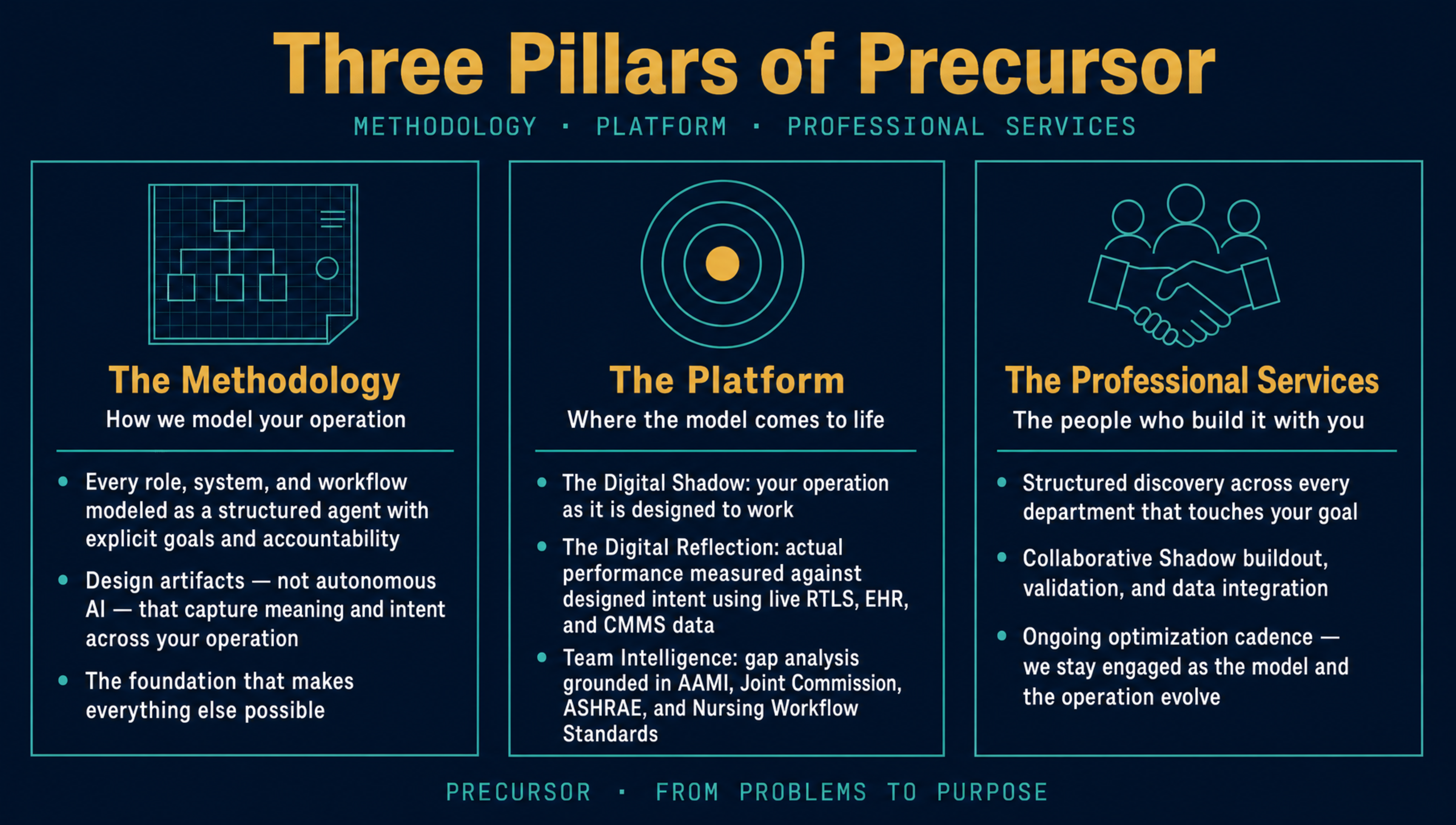
Three Pillars of Precursor illustration showing three equal panels: The Methodology — how we model your operation; The Platform — where the model comes to life, including the Digital Shadow, Digital Reflection, and Team Intelligence; and The Professional Services — the people who build it with you. Header reads Three Pillars of Precursor. Footer reads Precursor — From Problems to Purpose.

When your operation is designed to achieve goals — not just solve problems — everything changes.
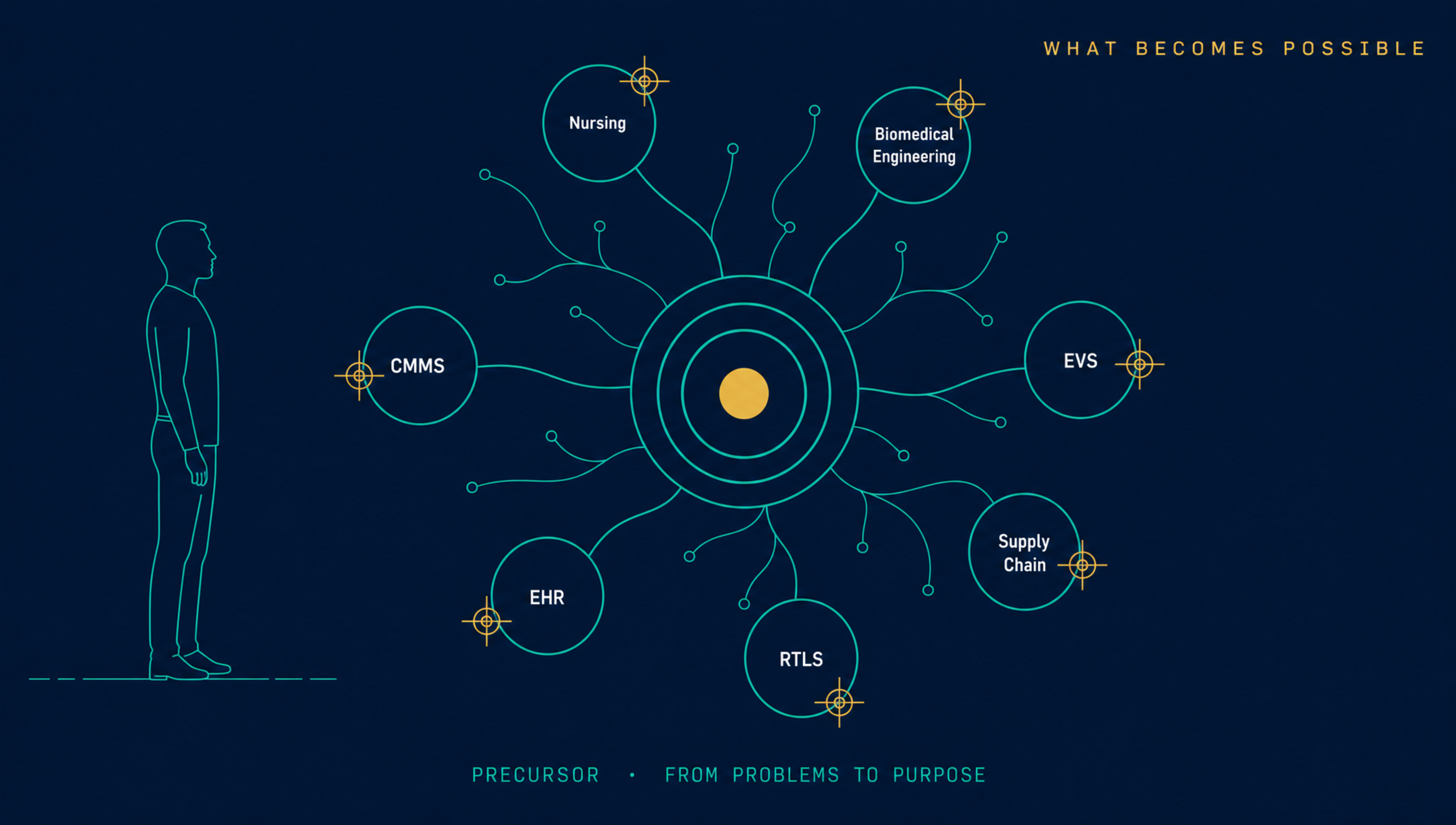
A healthcare operations leader stands looking at the Digital Shadow — the Precursor concentric rings at the center of a connected web of operational nodes including Nursing, Biomedical Engineering, EVS, Supply Chain, RTLS, EHR, and CMMS — each with a gold goal indicator. The scene conveys operational clarity and purpose. Labeled What Becomes Possible.

Start from Best Practice, Not a Blank Page

Every improvement project your team starts begins with the collective wisdom of AAMI, Joint Commission, ASHRAE, and Nursing Workflow Standards already applied to your specific operation. Not generic guidelines. Standards interpreted in the context of how your operation is actually designed to work.

Model Before You Commit

Before a single person moves, a single process changes, or a single dollar is spent — you can run the change against the Digital Shadow, see what the model predicts, and decide with confidence. Every recommendation comes with a prediction. Every prediction gets measured against what actually happened.

Know What You Don't Know

Most organizations don't know what they don't know. The Digital Shadow does. It shows you exactly where your operation has no visibility — where data gaps exist, where accountability is unclear, where goals are assumed but never measured. That's not a dashboard insight. That's an operational truth.

This is what it looks like when AI has something real to reason about.


Solving Problems Isn't the Same as Achieving Goals

Every healthcare operation runs on specialized systems — each one excellent at its own job. But excellence in isolation doesn't add up to an operation that works. Four ideas explain the gap the diagram below makes visible.

Problem-Driven

Each system is built to solve one isolated problem and succeeds on its own terms. RTLS confirms a pump's location, CMMS confirms it's maintained — yet no system owns whether it's actually available where care happens.

Goal-Driven

Every system is aligned to a single organizational outcome and measured against it. Availability at the point of need becomes a shared target — not a blind spot between four green dashboards.

Digital Shadow

A structured, goal-oriented model of your operation that AI can read and reason about. It connects people, processes, and technology to the goals they're meant to serve.

Point of Need

The place where the outcome actually has to happen — the bedside, not the database. A pump that's "in inventory" but three floors away has still failed the goal.
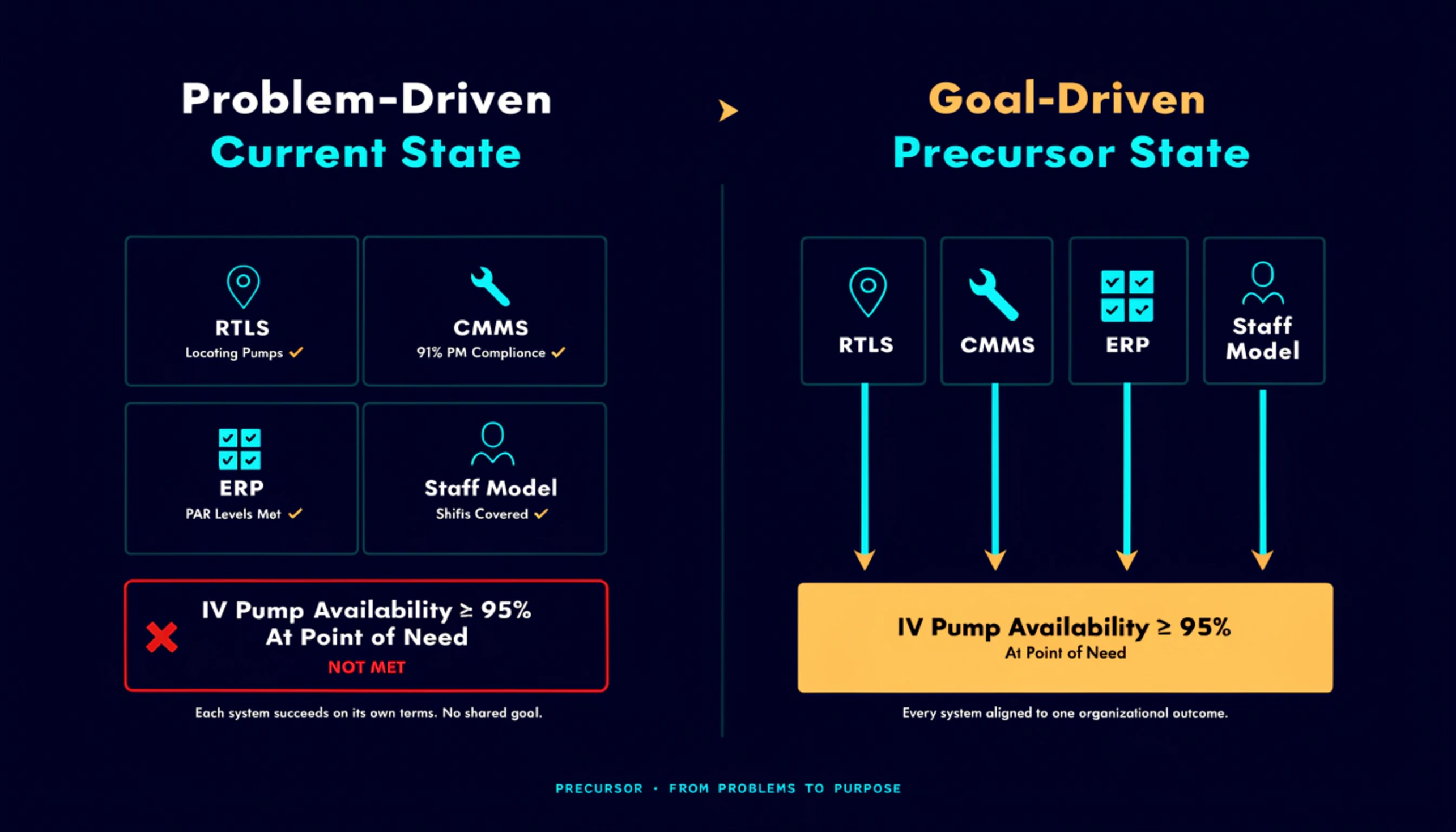
Key RTLS Real-Time Location System CMMS Computerized Maintenance Management ERP Enterprise Resource Planning Staff Model Workforce coverage
Comparison diagram: Problem-Driven current state shows RTLS, CMMS, ERP, and Staff Model each solving isolated problems with no shared goal. Goal-Driven Precursor state shows all four systems aligned to one organizational goal: IV Pump Availability greater than or equal to 95% at Point of Need.

From Problems to Purpose.
Three Phases.

Precursor works in three disciplined phases — each building on the last. Start with a model of your operation. Analyze it against the best practices in your industry. Then deploy changes with confidence, measure the results, and refine.

Phase 1

The Modeling Phase

Build a structured, goal-oriented model of how your operation works today (As-Is Shadow), design the future state you want to achieve (To-Be Shadow), and connect live data to measure whether the operation performed as designed (Digital Reflection).
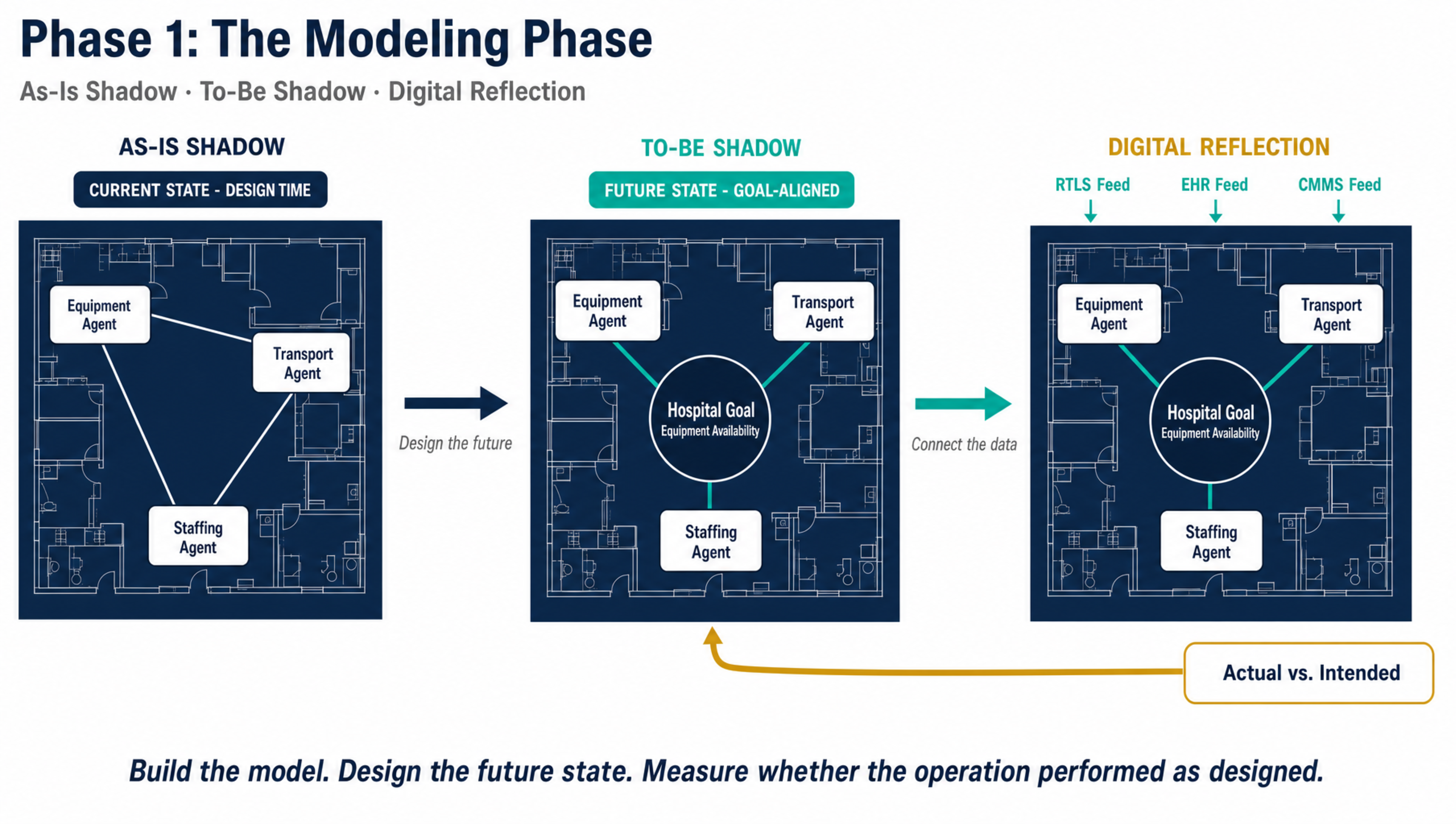
Phase 1: The Modeling Phase — showing As-Is Shadow, To-Be Shadow, and Digital Reflection as three connected stages
Phase 2

Team Intelligence

AI experts grounded in regulatory and code standards — AAMI, Joint Commission, ASHRAE, and Nursing Workflow Standards — analyze your Digital Shadow, surface gaps and misalignments, and generate a defensible roadmap. Your starting point is best practice, not a blank page.
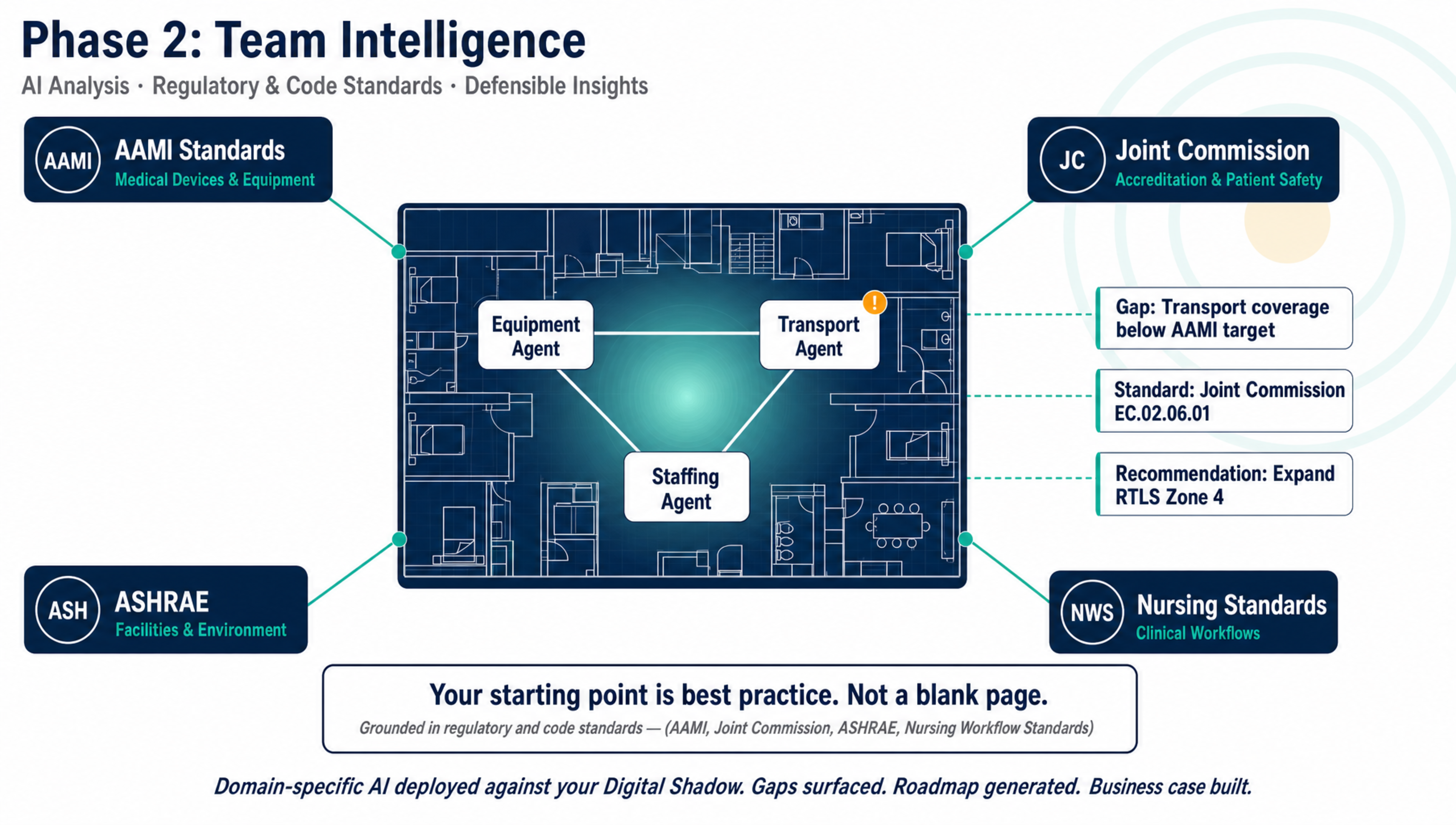
Phase 2: Team Intelligence — showing the Digital Shadow being analyzed by four professional standards bodies with insight outputs
Phase 3

Deployment Strategy

Deploy goal-oriented changes through disciplined iterations — model the change, predict the outcome, deploy and observe, then measure and refine. Small, frequent, observable improvements rather than high-risk transformation projects.
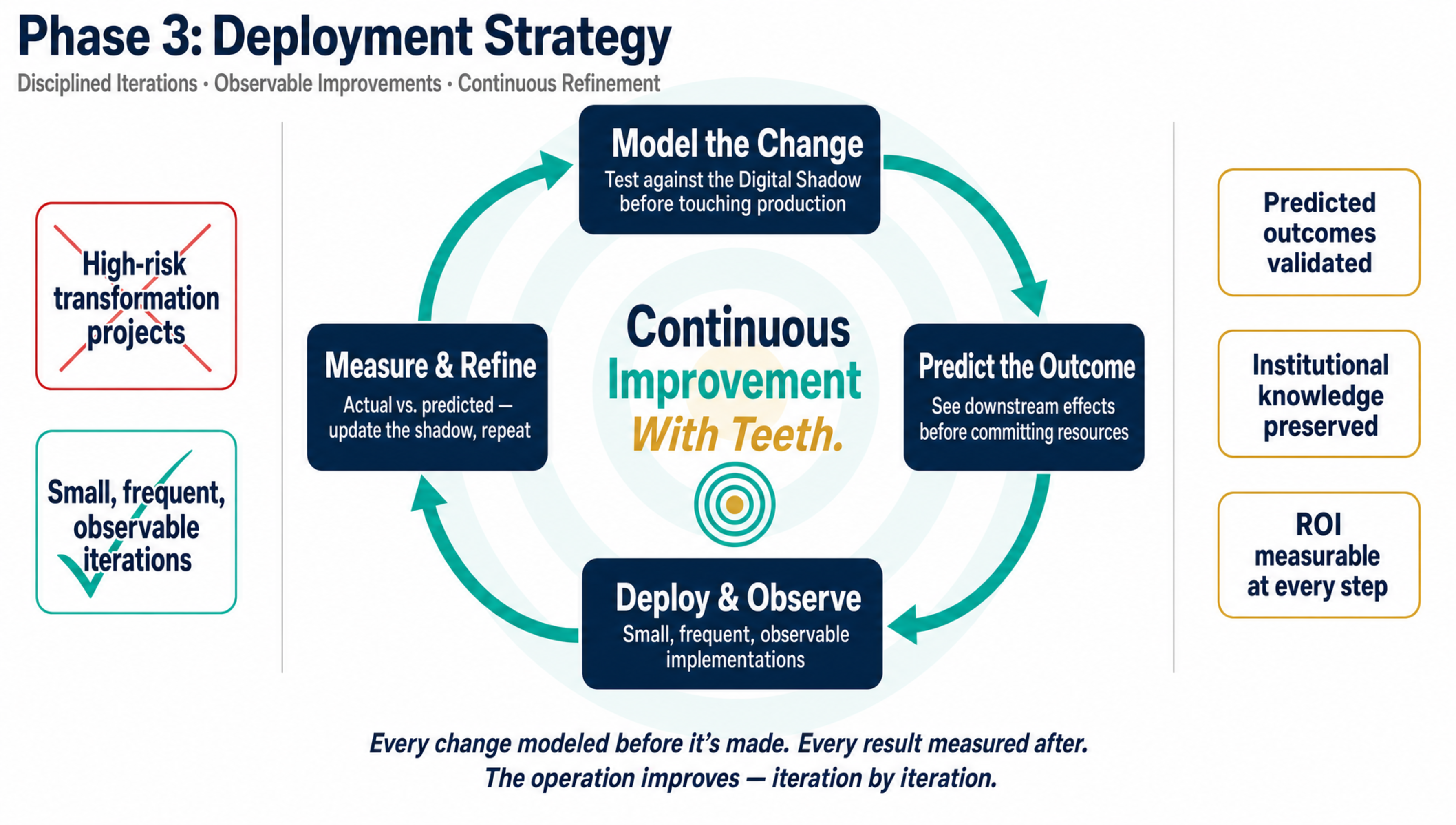
Phase 3: Deployment Strategy — showing the continuous improvement loop with four stages: Model the Change, Predict the Outcome, Deploy and Observe, Measure and Refine

Built for the People Who
Move Healthcare Forward

Whether you lead operations, drive improvement, or build the technology — Precursor meets you where you are.

Operations Leaders

You own the outcomes. Your technology stack is deep — but alignment is shallow. Precursor connects your tools to your mission.

Healthcare Improvers

You see the gaps others can't. Precursor gives you the analytical foundation and expert bench to drive measurable change.

Technology Vendors

Your product works. But customers want outcomes. Precursor makes your technology matter more — without competing with it.

Why Precursor Is Different

Not another dashboard. Not another point solution. A fundamentally different approach to operational intelligence.

Goal-Oriented, Not Problem-Oriented

We start with what you’re trying to achieve, not what’s currently broken. Problems are addressed in service of goals.

Predictive, Not Reactive

Model changes and predict outcomes before implementation. The Digital Shadow lets you see the future, not just react to the present.

Best-Practice Grounded

Team Intelligence brings the collective wisdom of professional organizations across healthcare, engineering, and operations.

Human Accountability

Agents don’t replace humans. They ensure human decisions are informed by complete operational context and aligned with goals.

Ready to Align Technology
with Purpose?

See how the Digital Shadow transforms healthcare operations.
Methodology

From Goals to
Goal-Oriented Systems

Five disciplined steps that transform how your organization connects technology to purpose. Every step is observable, measurable, and grounded in best practices.


1. Define Organizational Goals 2. Build the Digital Shadow 3. Analyze with Team Intelligence 4. Model Changes Before You Make Them 5. Implement, Observe, Learn Continuous Improvement With Teeth. Small. Frequent. Observable.
1. Define Organizational Goals
Start with what your organization is trying to achieve — not what’s broken. Goals cascade from mission and vision down to individual contributors. Every agent, every workflow, every measurement traces back to purpose.
2. Build the Digital Shadow
Model your people, processes, and technologies as semantic agents using agentic design. The result is a living blueprint that AI can read, reason about, and use to ensure every decision aligns with your goals.
3. Analyze with Team Intelligence
AI experts — each grounded in their discipline’s professional standards — analyze your operations, identify misalignments, and surface opportunities invisible to siloed dashboards.
The Digital Shadow AAMI Standards Medical device & equipment ASHRAE Guidelines Facilities & environment Nursing Workflow Standards Joint Commission Accreditation & safety
4. Model Changes Before You Make Them
Test proposed changes against hypothetical states. Predict outcomes. Compare options. The digital shadow lets you see the future impact of today’s decisions.
5. Implement, Observe, Learn
Deploy changes through small, frequent, observable iterations. Compare predicted outcomes to actual results. Refine. Repeat. This is operational CI/CD — continuous improvement with teeth.

Why Precursor Is Different

Not another dashboard. Not another point solution. A fundamentally different approach to operational intelligence.

Goal-Oriented, Not Problem-Oriented

We start with what you're trying to achieve, not what's currently broken. Problems are addressed in service of goals.

Predictive, Not Reactive

Model changes and predict outcomes before implementation. The digital shadow lets you see the future, not just react to the present.

Best-Practice Grounded

Team Intelligence brings the collective wisdom of professional organizations across healthcare, engineering, and operations.

Human Accountability

Agents don't replace humans. They ensure human decisions are informed by complete operational context and aligned with goals.

See the Methodology in Action

Walk through a live demonstration of the Digital Shadow and Team Intelligence.

Our Process

We Do the Heavy Lifting.
You Own the Outcomes.

Building a Digital Shadow isn't a software implementation — it's a structured engagement. Precursor consultants embed with your team, do the discovery work across every department that touches your goal, build and connect the model, and deliver the analysis. Here's exactly how it works.


Discovery

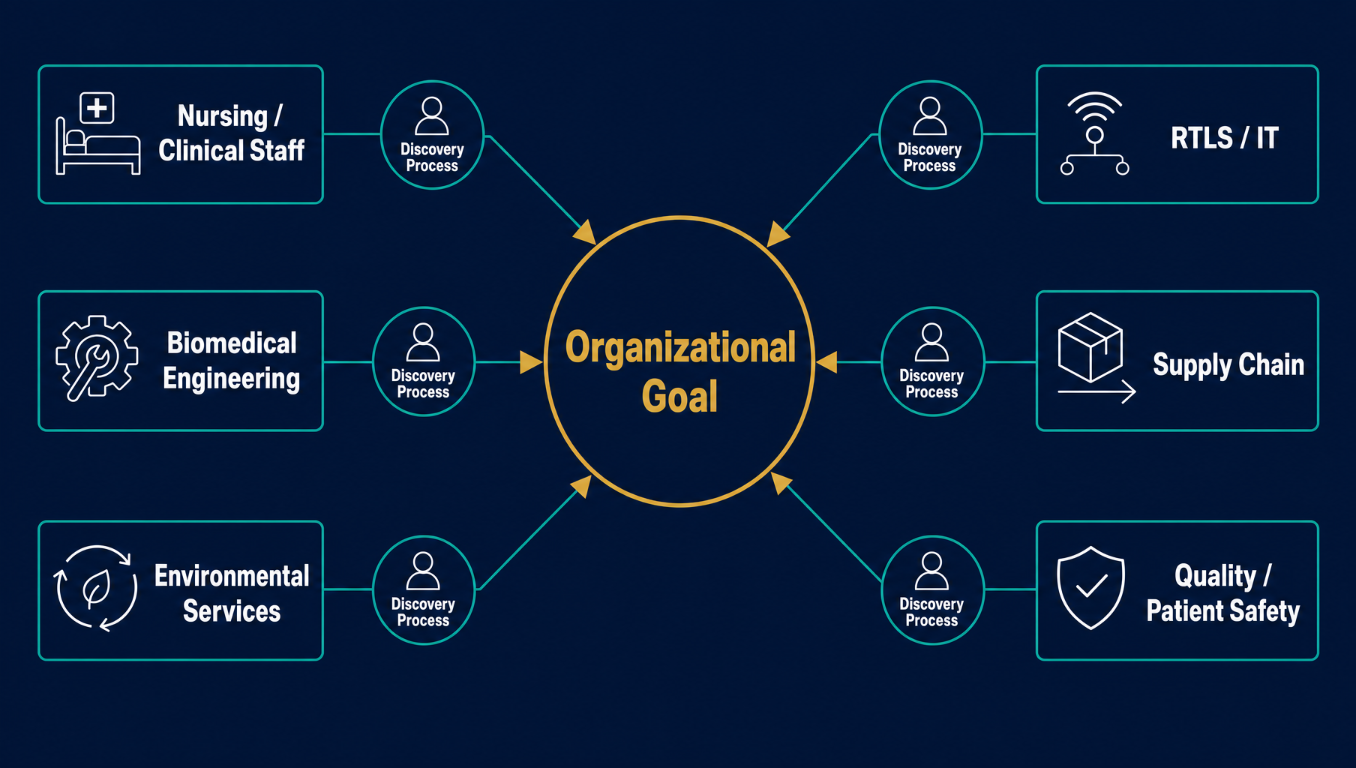
Before anything is built, we need to understand how your operation actually works — not how it's documented to work. A Precursor consultant conducts structured discovery sessions across every department that touches your goal. Nursing, Biomedical Engineering, EVS, Supply Chain, RTLS/IT, Quality — each session is designed to surface the goals, workflows, decision points, workarounds, and data sources that will populate the Digital Shadow. We do floor observation, not just interviews. We talk to the people who do the work, not just their managers.

Discovery illustration showing six departments — Nursing, Biomedical Engineering, Environmental Services, Supply Chain, RTLS/IT, and Quality/Patient Safety — each connected through a Discovery Process node feeding into a central Organizational Goal

Goal Formalization

We start by translating your stated goal into a formal, measurable definition with agreed success criteria and a baseline. Every subsequent decision traces back to this anchor. No goal means no shadow.

Departmental Sessions

Structured discovery conversations with every department that touches the goal-related workflow. We surface how work actually happens — including the workarounds, informal practices, and cross-department friction points that never appear in an org chart.

Pre-Work Assessments

Each department completes a structured pre-work assessment before their session. This surfaces baseline data, flags known gaps, and ensures discovery conversations go deeper faster.

Data Source Mapping

We identify every system generating relevant data — RTLS, CMMS, EHR, and others — and assess integration options, data quality, and known gaps before buildout begins.

Digital Shadow Buildout

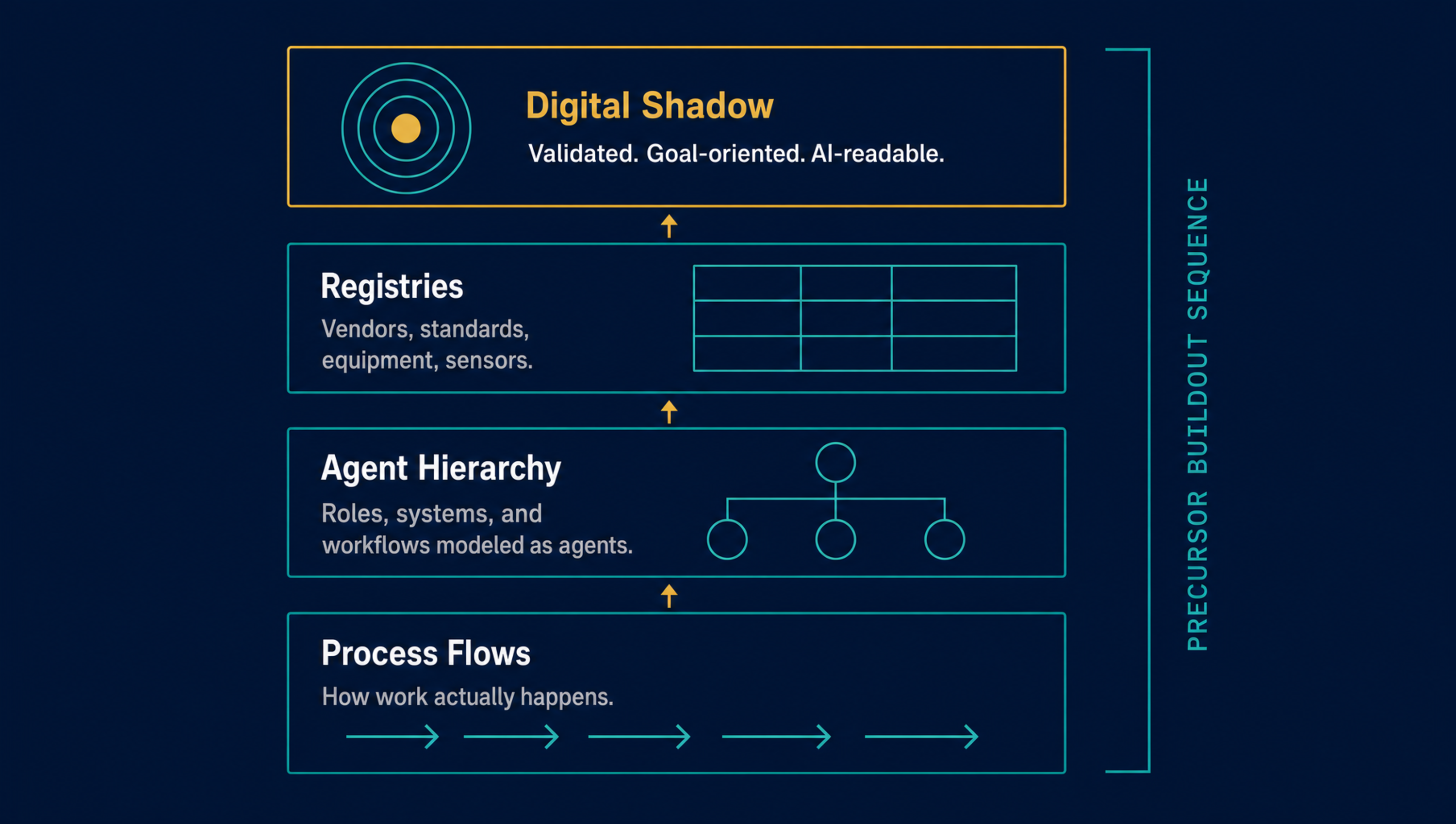
Everything gathered in discovery gets translated into a working Digital Shadow — a structured, goal-oriented model of your operation that AI can read, reason about, and use to evaluate every decision against your organizational goals. The consultant owns the architecture and configuration, while working collaboratively with your team to validate that the Shadow accurately represents your operation at each stage.

1
Process Flow Documentation
We document current-state process flows for all goal-related workflows — validated by operational staff, not just management. These become the scaffolding for the agent model.
2
Agent Hierarchy Definition
Every role, system, and workflow that touches your goal is modeled as a structured agent with explicit goals, defined inputs, available actions, and measurable performance targets. These aren't AI agents taking autonomous actions — they're design artifacts that capture meaning, intent, and accountability across your operation.
3
Registry Configuration
We build and populate the registry structures that give the Shadow its operational context — vendors, standards, regulations, actors, facilities, equipment, and sensors. Each registry entry is validated with the relevant departmental stakeholder and assigned a named owner for ongoing accuracy.
4
Current State Validation
We run the Shadow in current-state mode and present the output to your team. The Shadow must match operational reality before we proceed. Discrepancies are learning — we update the model until it accurately reflects how your operation actually works.
Digital Shadow buildout sequence showing four layers stacked vertically: Process Flows at the base, then Agent Hierarchy, then Registries, with the validated Digital Shadow at the top — labeled Precursor Buildout Sequence

Digital Reflection

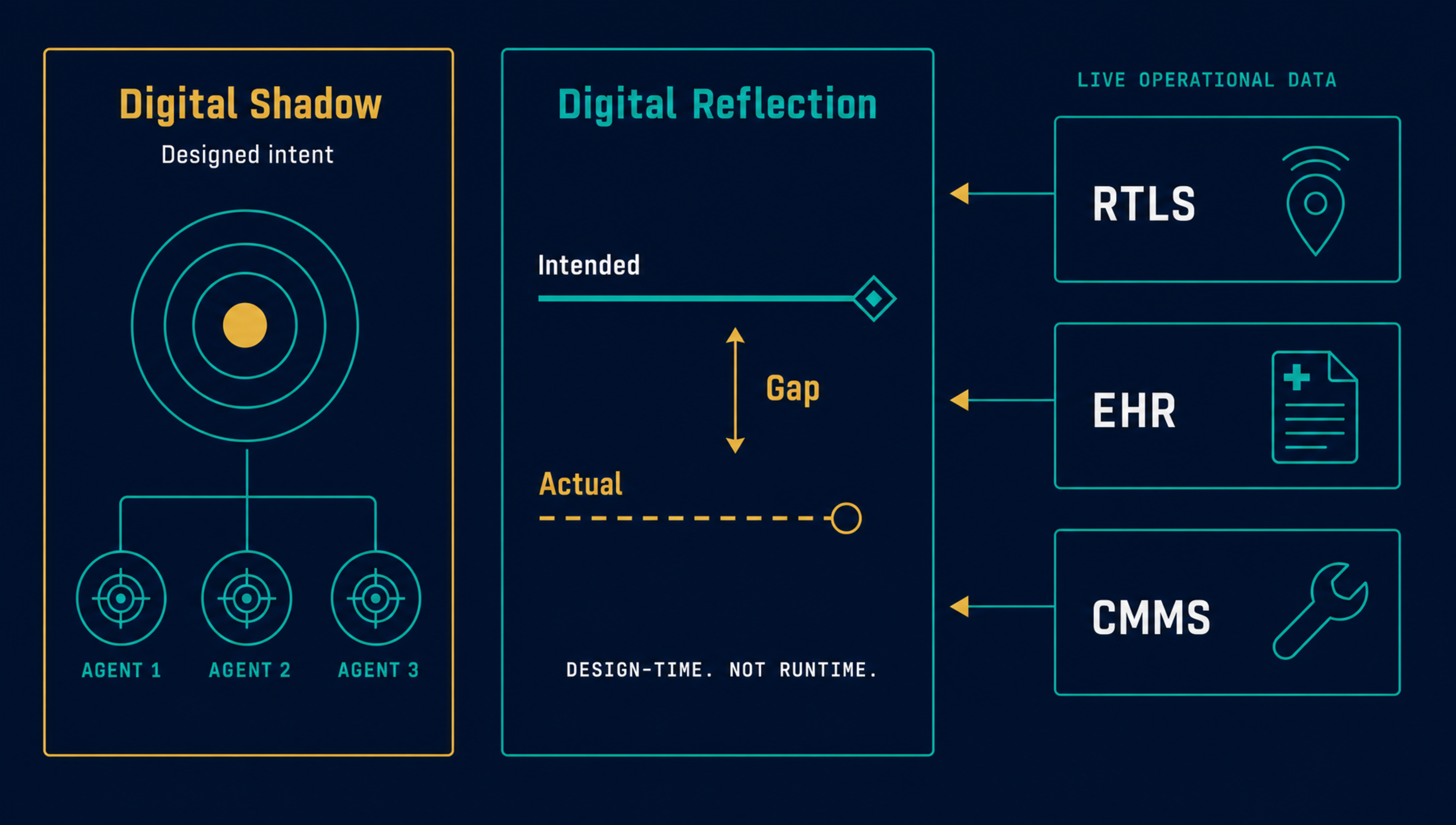
Once the Digital Shadow is validated, we connect it to live operational data from your existing systems — RTLS, EHR, CMMS, and others identified in discovery. This connection is the Digital Reflection: the Shadow activated by real data, continuously comparing actual performance against designed intent.

Actual vs. Intended
Design-time, not runtime

The Digital Reflection is not a dashboard. A dashboard shows data. The Reflection shows data in the context of goals, agents, and designed intent. The insight isn't "registrations are down" — it's "this specific agent is underperforming against its target, and here is what that means for the agents around it."

Critically, the Reflection remains design-time. Operational data is used within the planning horizon to inform design decisions — not to trigger real-time responses. Precursor does not operate your organization. It informs how your organization should be designed to operate.

For RTLS partners, the Reflection surfaces something additional: exactly where data coverage gaps exist — areas where the data can't close the loop on performance — and what closing those gaps would mean for goal attainment.

Digital Reflection illustration showing the Digital Shadow on the left with designed intent, a center comparison panel showing the gap between Intended and Actual performance labeled Design-Time Not Runtime, and live operational data feeds — RTLS, EHR, and CMMS — on the right feeding into the comparison layer

Team Intelligence

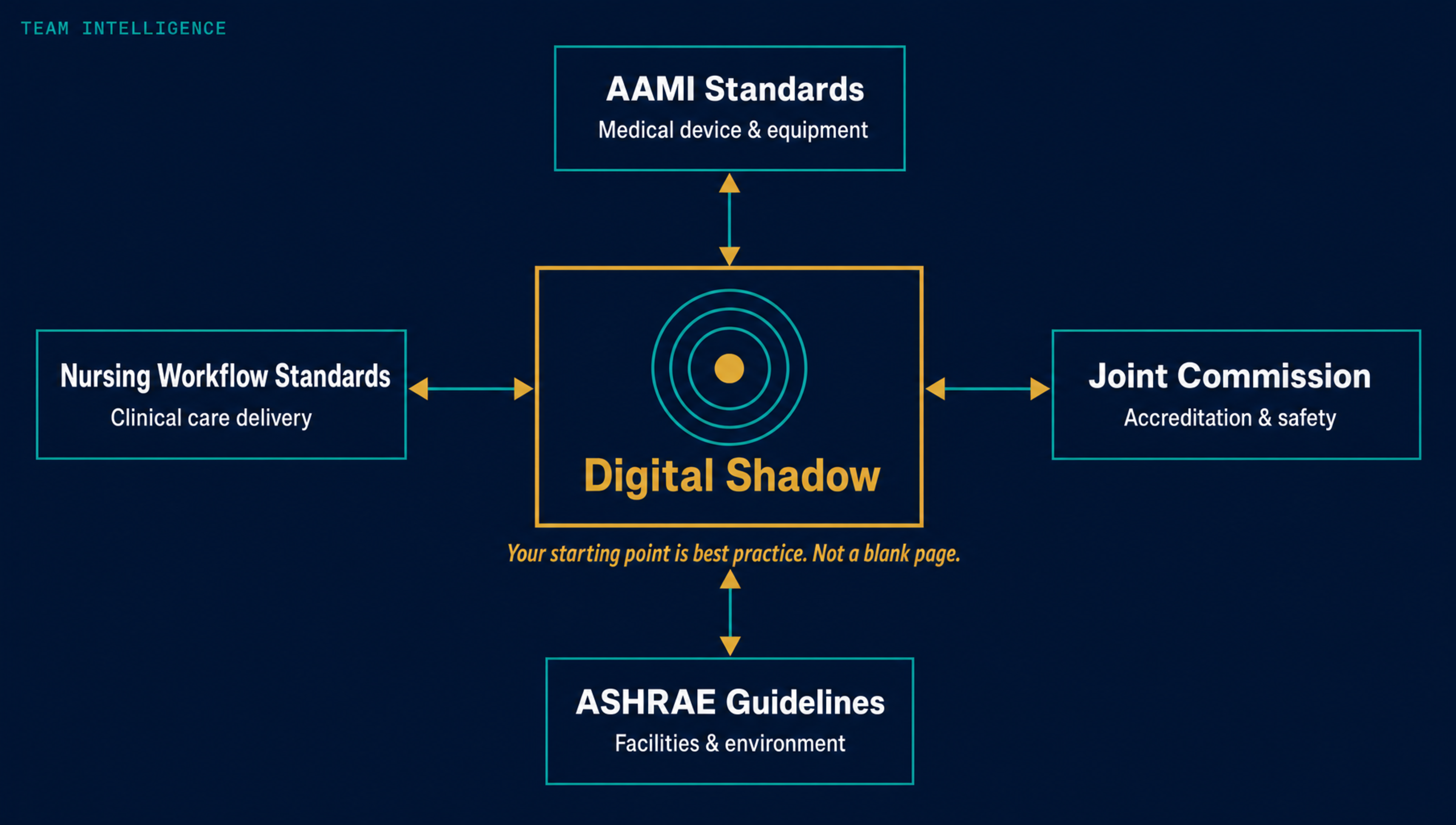
With the Digital Shadow validated and the Digital Reflection connected, Team Intelligence analyzes your operation against the professional standards that govern it. Your starting point isn't a blank page — it's the collective wisdom of the highest standards in your industry.

Team Intelligence illustration showing the Digital Shadow at the center connected by bidirectional arrows to four professional standards bodies: AAMI Standards at top, ASHRAE Guidelines at bottom, Nursing Workflow Standards on the left, and Joint Commission on the right — with the caption Your starting point is best practice. Not a blank page.

Standards-Grounded Analysis

AI experts grounded in AAMI, Joint Commission, ASHRAE, Nursing Workflow Standards, and other domain-specific standards analyze your Digital Shadow, surface misalignments, and identify gaps invisible to siloed dashboards.

Hypothetical State Modeling

Before any change is recommended, we model it in hypothetical mode. Every recommendation includes an explicit, measurable prediction — not "this should improve availability" but a specific predicted outcome with a timeline.

The Team Intelligence UI

Your team accesses the Digital Shadow and Team Intelligence analysis through the Precursor platform — a purpose-built interface for viewing agent performance, exploring gap analysis, and managing the improvement roadmap against your organizational goals.

Ongoing Optimization

The Digital Shadow is a living system, not a one-time deliverable. After initial delivery, Precursor establishes the rhythms and disciplines that turn the Shadow from a project into a capability — and turn Precursor from a vendor relationship into a long-term operational partnership.

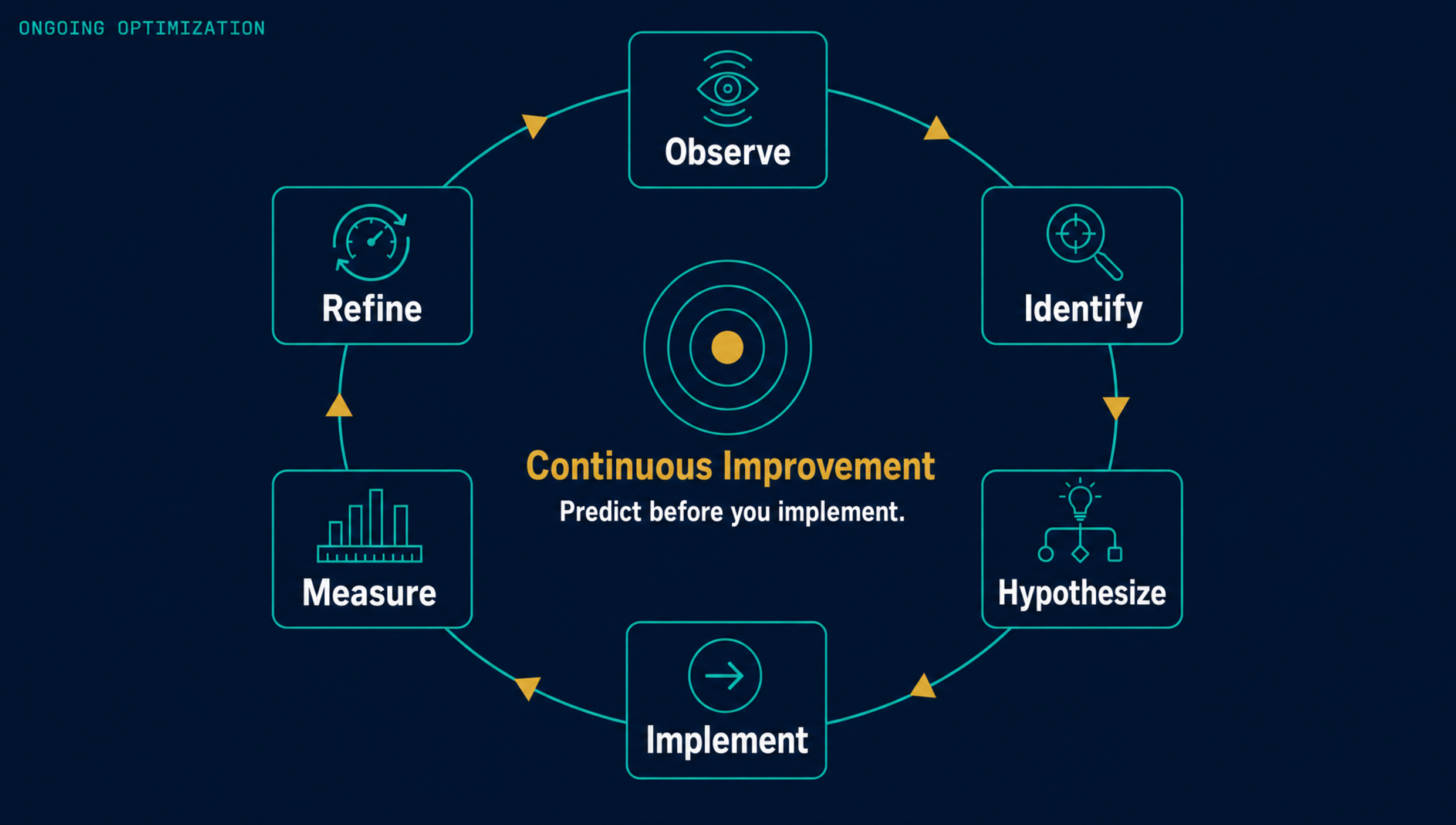
Ongoing Optimization illustration showing a six-step clockwise improvement cycle: Observe, Identify, Hypothesize, Implement, Measure, Refine — with the Precursor concentric rings icon at the center labeled Continuous Improvement and the caption Predict before you implement.

The Improvement Cycle

Every improvement follows the same discipline: Observe → Identify → Hypothesize → Implement → Measure → Refine. We predict before we implement. The delta between prediction and actual result is the most valuable thing we produce.

Structured Cadence

Weekly tactical check-ins, monthly goal progress reviews with operational stakeholders, quarterly executive reviews with ROI validation, and annual comprehensive model reviews to catch drift that accumulates in small increments.

Shadow Model Maintenance

The Shadow degrades in accuracy if it isn't maintained. We assign named client owners for each registry, establish review triggers, and define what constitutes a material change requiring a model update versus routine maintenance.

Expansion by Evidence

A successful engagement reveals where the methodology can go next — another goal, another department, another domain. Expansion conversations are grounded in what the Shadow shows, not in a sales pitch.

Ready to See It
Applied to Your Operation?

Walk through a live demonstration of the Digital Shadow and Team Intelligence using a goal relevant to your organization.

For Operations Leaders

Your Dashboards Are Green.
Your Outcomes Are Red.

You've invested in the best technology. Every vendor says their system is working perfectly. But the gaps between systems — the alignment gaps — are where outcomes fall apart. Precursor closes those gaps.


Sound Familiar?

Technology Silos

Each system works in isolation. No one sees the complete operational picture. Integration exists at the data level but not at the goal level.

Reactive Decision-Making

You're constantly putting out fires. Every solution creates a new problem somewhere else. You can't predict the downstream effects of changes.

Misaligned Metrics

Departments optimize for their own KPIs while organizational goals suffer. What looks like success in isolation is failure in context.

No Operational Blueprint

The knowledge of how your operation actually works lives in people's heads, not in a system. When key people leave, institutional knowledge goes with them.

How Precursor Helps You

The Digital Shadow gives you a complete, goal-oriented model of your entire operation. For the first time, you can see how every system, every process, and every role connects to — or conflicts with — your organizational goals.

Team Intelligence provides expert analysis grounded in best practices across every discipline your operation touches. Model changes before you make them. Predict outcomes. Deploy with confidence and measure the results.

Stop Managing Dashboards.
Start Achieving Goals.

See how the Digital Shadow can transform your operational visibility.

For Healthcare Improvers

You See the Gaps.
Now Close Them.

Process improvers, quality leads, Lean Six Sigma practitioners, consultants — you know where operations break down. Precursor gives you the tools to prove it, model the fix, and measure the result.


Precursor as Your Analytical Foundation

Complete Operational Context

The Digital Shadow captures people, processes, and technologies in one model. No more piecing together information from twenty different systems and interviews.

Expert Bench on Demand

Team Intelligence provides discipline-specific expertise grounded in professional standards. It's like having a department of specialists supporting every analysis.

Model Before You Act

Test proposed changes against the Digital Shadow before implementation. See downstream effects. Compare scenarios. Build the business case with predicted outcomes.

Measure What Matters

Every change is observable. Compare predicted outcomes to actual results. Build a track record of improvement that's grounded in data, not anecdotes.

From Insight to Impact

You've always known where the problems are. Precursor gives you the analytical rigor to quantify the gap, model the solution, predict the outcome, implement with discipline, and prove the result. Your expertise, amplified by operational intelligence.

Your Expertise.
Amplified.

See how the Digital Shadow becomes your analytical foundation.

For Technology Vendors

Your RTLS Works.
Make It Matter More.

Precursor doesn't compete with your technology — it amplifies it. When customers ask "We know where everything is — now what?" Precursor is your answer.


From Location Data to Operational Outcomes

Bridge the "Now What?" Gap

Your RTLS delivers location intelligence. Precursor connects that intelligence to organizational goals — turning data into outcomes your customers can measure.

Elevate Your Value Proposition

Stop selling location tracking. Start selling operational outcomes. Precursor makes your RTLS the sensing infrastructure for goal-oriented operations.

Deepen Customer Relationships

When your technology is embedded in your customer's operational intelligence, it becomes indispensable. Not because of the data — because of the outcomes.

No Conflict, Only Complement

Precursor uses your RTLS as primary sensing infrastructure. We don't replace what you do — we make what you do matter more to your customers.

A Partnership Built on Alignment

Your RTLS technology provides high-accuracy location, utilization, and movement data. Precursor's Digital Shadow models that data within the context of your customer's organizational goals. Together, you deliver something neither can alone: goal-oriented operational intelligence powered by real-time sensing.

Let's Build Together

Explore how Precursor can amplify your technology's impact.

Our Story

Built by Someone Who
Lived the Problem.

Precursor wasn't conceived in a boardroom. It came from 20+ years of watching great technology fail to deliver on the outcomes it promised — and deciding to do something about it.


From Problems to Purpose

The insight behind Precursor starts with radar.

Paul Zieske began his career installing airport radar systems for Westinghouse and the FAA — where he learned a fundamental truth: the system isn't the radar. It's the picture the radar builds, and the decisions you make from it.

That thinking followed him into healthcare. During 13 years at Henry Ford Health in RTLS and indoor positioning, he kept seeing the same problem at scale: too many moving parts, not enough situational awareness. Every system was doing its job. The operation was still falling short.

He incubated a solution through the Henry Ford Innovation Institute, filed a patent, and spun it out as Navv Systems — an early thesis on Care Traffic Control for modern healthcare operations. The thesis was right. The market wasn't ready.

So he wrote the book. Why Where Matters makes the case for operational situational awareness in healthcare — a concept Paul helped define — and lays out why hospitals need a real operational model, not another dashboard.

He joined the Digital Twin Consortium and kept developing the methodology. That's when the gap became impossible to ignore: everyone was building AI agents that do things. Nobody was building the model those agents needed to actually understand the operation.

That gap was the idea for Precursor Agentic.

Paul Zieske — Founder & CEO

Paul Zieske, Founder & CEO of Precursor Agentic
Paul Zieske
Founder & CEO, Precursor Agentic

Henry Ford Health — 13 Years RTLS
Westinghouse / FAA — Radar Systems
Digital Twin Consortium — Member
Author, Why Where Matters

Paul Zieske is the founder and CEO of Precursor Agentic. His career spans two decades at the intersection of sensing technology, operational intelligence, and healthcare systems — giving him a rare vantage point on why technology investments so often fall short of their operational promise.

He began his career with Westinghouse and the FAA, installing airport radar systems — infrastructure where the gap between raw data and actionable situational awareness is literally a matter of safety. That formative experience shaped how he thinks about every technology system since: the output isn't the data. It's the picture you build from it, and the decisions you make from that picture.

At Henry Ford Health, Paul spent 13 years leading RTLS and indoor positioning programs — one of the longest and deepest tenures in healthcare RTLS in the industry. He incubated the concept of Care Traffic Control through the Henry Ford Innovation Institute, filed a foundational patent, and spun out Navv Systems to bring the idea to market. Along the way, he co-authored Why Where Matters, which makes the case for a new model of healthcare operational intelligence — one grounded in goals, not just data.

Precursor Agentic is the culmination of that journey: a platform purpose-built to give healthcare organizations the goal-oriented operational model that every other system assumes exists but none of them actually builds.

Our Mission

Precursor exists to close the gap between technology investment and operational outcomes in healthcare. We believe that goal-oriented operational intelligence — grounded in best practices and powered by AI — is the missing layer that makes everything else work better.

Built on Experience.
Designed for Outcomes.

See how Precursor's Digital Shadow turns operational complexity into goal-aligned clarity.